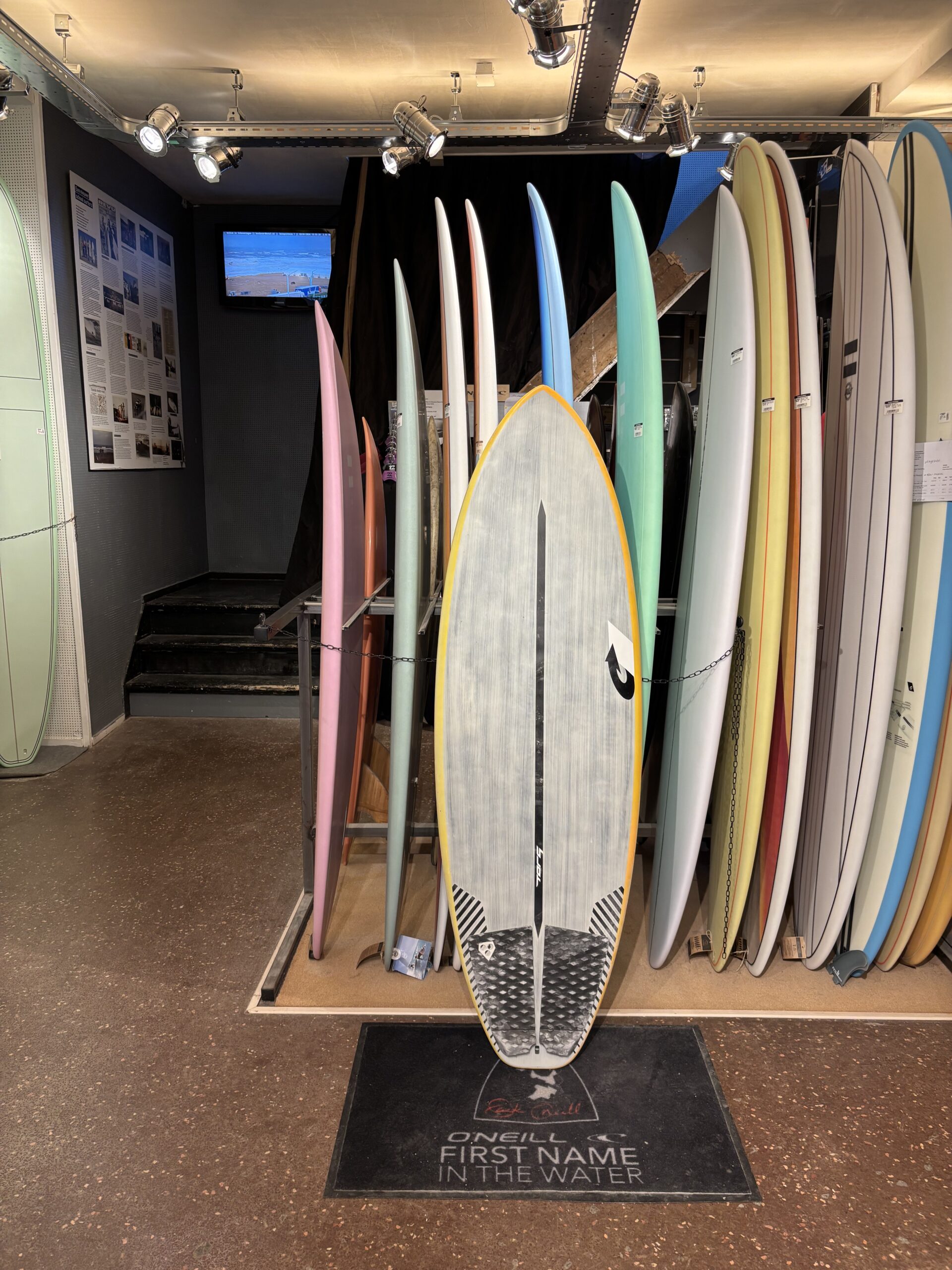
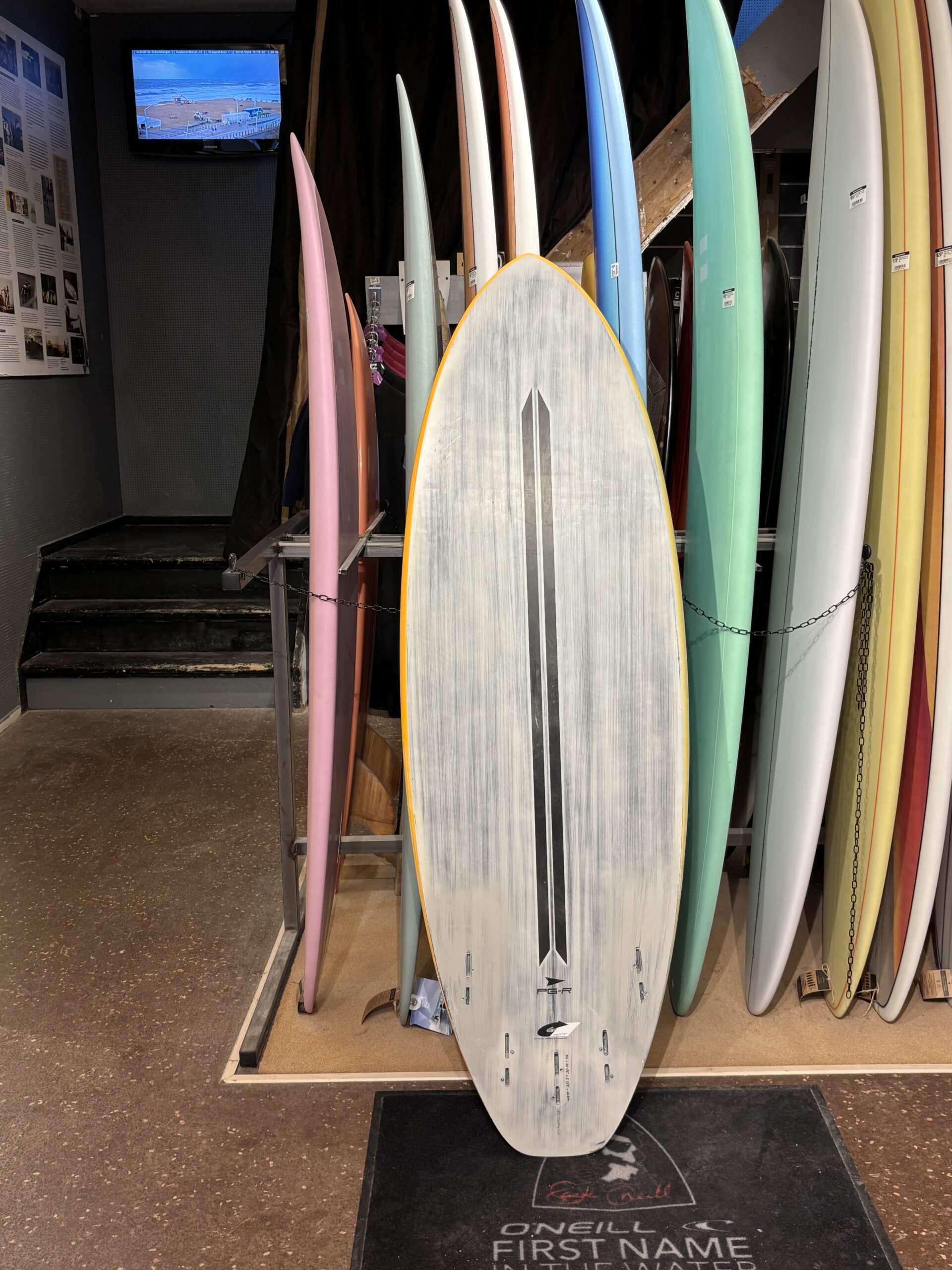
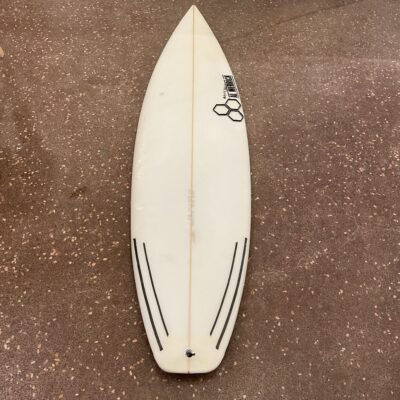
Used Torq PG-R 5’6 x 20 1/2” x 2 3/8” 30.6 ltr

325.00

In stock

Description

The PG-R the most important board in your quiver. It’s the board you’ll surf 80% of the time in less than stellar waves so it needs to be excellent.

We designed the PG-R to handle average, everyday surf. It’s fast with easy paddling and pick up, intended to be our Performance Groveller – able to skate over the flats but capable in critical sections.

The by-product is a board that lends itself to progression. It’s stable and reassuring so you have the confidence to push harder. It generates and carries speed that converts into big turns or airs. You can lay it on a rail and it gives back tenfold. It’s a board that lets you up your game, no matter the conditions.

Fin(s) included: None.

Construction – ACT

Torq ACT surfboards are the world’s first EPS/Epoxy pre-preg surfboards. Pre-preg is the most high performing composite process, best strength to weight ratio and reflex (spring) characteristics in any fibreglass lay-up.

That’s a big claim, here’s some more:

“Prepreg fabrics virtually eliminate process variation found in traditional layups or vacuum infusion processes. As a result, prepregs have revolutionized composite fabrication”

They have “Maximum strength properties” “Less mess and less waste. All of the excesses of hand layup – cups of resin, messy rollers, drips – are no longer a problem.”

“Without the pitfalls of human lamination techniques, there will be neither resin-rich areas nor dry spots.” “Prepregs are regarded as the most advanced system of composite fabrication.”

These are quotes from industry sources, websites and information manuals. Do a google search of ‘pre-preg composites’ and you’ll find pages of this stuff. It’s unanimously accepted as the most advanced composite process.

What is it?

Pre-preg is short for pre-impregnated. The resin and catalyst are applied by machine to the fiberglass cloth to create a fiber resin matrix.

The matrix has perfect resin hardener mix and perfect resin content and distribution.

The matrix is cut by machine (we have cutting files for each of our models and sizes so the exact correct fiber and resin weight is used on every board) then laid up on the surfboard form and cured under high heat and pressure in an oven.

Reflex or spring:

Hand laminates, even when vacuum bagged, end up with a significant amount of excess resin. This adds weight, increases brittleness and limits the fibers properties as it’s bound in a thick shell.

Pre-pregs are machine impregnated with the perfect resin density. Regardless of what fiber is used – glass, carbon, basalt – the pre-preg process allow fiber to perform without the limitation of excess resin.

In surfboards this translates to a springy responsive feeling. Any flex that is pushed into the board through a turn is directly returned in reflex, not deadened by the resin. They give back all the energy loaded into them. Because the board is allowed to flex naturally, they absorb a lot more of the chatter than can be associated with lightweight epoxy boards.

Strength to weight ratio.

The other advantage of no extra unnecessary weight of excess resin is the extra amount of fiber we can use, for the same overall board weight. ACT’s have a heavy duty fiber lay-up making them significantly stronger than a similar weight surfboard in any other construction.

We have 2-3 times the fiber in these boards for the same weight of a lightweight PU. They’re not our strongest boards, but have much greater strength to weight ratio.

How do they surf?

They feel alive from the get go.

The feel is between a light PU and Epoxy with an extra spring not found in either technology. They feel pretty familiar to both so take very little time to adapt to. But once used to, any other board feels flat by comparison.

Brand

Torq-surfboards

Launched in 2012, torq surfboards created a new standard in the epoxy surfboard market, offering an unmatched combination of strength and performance. This year sees the innovation step up a gear, with new shapes, new graphics and new technologies. The torq range now offers 4 types of boards for all levels of surfer. Torq TEC; Torq Epoxy Composite offers our user friendly performance shapes in our most advanced epoxy lay-up to date. Using a mix of Biaxial, plain weave fibres and Carbon, these boards offer the best strength to weight ratio on the market. Torq X-Lite is a brand new Epoxy technology developed specifically for performance boards. This is stronger and more Eco than a traditional PU/Polyester board. This new innovative technology is used exclusively on the Channel Islands model, the POD MOD Torq Epoxy Technology or TET represents a revolution in Epoxy surfboard technology. Built using the latest in EPS/Epoxy materials; the Torq Epoxy Technology combines a lightweight EPS core with Biaxial fibreglass cloth, Epoxy resin and our unique Shield Skin. Our Soft Deck board uses an additional PE deck skin over a full laminated core to offer a safe first time learning option in this durable easy surfing range.

THERE ARE MANY ASPECTS TO SURFBOARD SELECTION THESE ARE THE POINTS TO CONSIDER

LENGTH

Typically surfboards are measured in inches. The length is measured from the nose to the tail. Choosing the length of the surfboard is dependant on your size (weight, height), board type and waves conditions you wish to use the board for.

WIDTH

The widest point of the surfboard is measured from rail to rail. Generally the wider the surfboard the more stable the board, while a board with smaller width maintains better speed and performance.

BOARD THICKNESS

Surfboard thickness is measured from the top deck to the bottom. The thickness again has a bearing on the board’s performance. Professional surfers will tend to go for the thinner boards as they are lighter and offer better performance.The thicker boards are stronger and because there is more foam under the surfer the boards are more stable.

ROCKER

The bottom curve of a surfboard. Generally the more rocker the surfboard has the more loose (manoeuvrable) the surfboard will be. Where the flatter rocker surfboards will be faster, although they will lack the looseness. The nose is the tip of the surfboard, the nose can vary in shapes and size. Basically the thinner the nose the more response the board will perform, while wider noses are better for stabilization.

STRINGER

Used to increase the strength of a surfboard, a stringer (normally made from wood) runs down the length of a surfboards (typically in the centre of the board from the tip of the nose to the tail). Boards built with Epoxy, Carbon Fibre and soft boards generally don’t have stringers.

FINS

Generally heavier surfers require larger fins to hold the waves better. Although if you prefer to ride a looser (less hold in the waves), smaller fins would be a better option.

FIN CONSIDERATIONS

Fin configurations have an effect on the ways your surfboards perform. The following are some of the more common fin configurations.

SINGLE FIN

The single fin was the original fin configuration for surfboards. Based on the idea of the sailboat keel. Single fins are added stabilization and control on the powerful, larger waves, although lack manoeuvrability

TWIN FIN

Are great for small waves, being fast and manoeuvrable, but when put into tight spots on larger waves, they become hard to control. Popular with Fish surfboards.

THRUSTER 3 FIN

Widely recognized as the standard fin configuration, the thruster answers the shortcomings of the single fin and the twin fins configurations. The thrusters give you stabilization, control and manoeuvrability in all types of surfing conditions. This concept was the brainchild of Australia’s Simon Anderson

QUADS 4 FINS

With four fins in the water, Quads boasts an extraordinary amount of holding power in larger surf. You may think that having four fins would sacrifice speed by creating more drag, but this is not the case. The both sets of fins are working together on the rail, which makers believe they creates less drag than a board with a centre fin. The manoeuvrability isn’t sacrificed either, with fins directly under your back foot, the quads are very responsive.

KEEL

Similar setup to the Twin Fin, although smaller (low profile) fins are generally placed wider (closer to the rails) on the surfboard. Popular with Fish and Egg / Retro surfboards.
Heeft u hulp nodig bij uw aankoop? Neem dan gerust contact met ons op +3170 201 5153 info@noordzeeboardstore.nl

Contact formulier

     
    0
      0
      Your Cart
      Your cart is empty